What Good Swimming Pool Water Treatment in Delhi Actually Requires
Swimming pool water treatment in Delhi is a different challenge from what most standard pool maintenance guides describe. The reason is straightforward: the water here is hard, the summers are extreme, and the dust load on an outdoor pool between March and June is significant. A treatment approach designed for softer water regions or more temperate climates will underperform here consistently. After 25 years of maintaining and constructing pools across Gurugram, Noida, and Delhi, I can say that water chemistry is the single issue property owners most consistently underestimate.
Getting it wrong is expensive. Getting it right is largely a matter of understanding what is actually in the water you are working with.
Why Delhi NCR’s Water Makes Pool Treatment Harder
The municipal water supply across Delhi, Gurugram, Noida, and Faridabad carries a high total dissolved solids count. TDS in this region typically runs between 500 and 900 mg/L, sometimes higher depending on the source and season. For a swimming pool, this matters because dissolved calcium and magnesium in the water react with chlorine, with pool surfaces, and with each other in ways that create ongoing problems if not actively managed.
The most visible result is scale. White or greyish deposits on pool walls, around fittings, and along the waterline are calcium carbonate coming out of solution as the water heats up. Beyond being aesthetically poor, scale build-up on an RCC pool surface creates a rough texture that traps algae at a microscopic level, makes the pool harder to clean, and over time begins to affect the surface integrity. A hotel pool on Golf Course Road we assessed last year had scale deposits that had been forming unchecked for three seasons. The surface work required to address it was far more involved than the chemical treatment would have been.
The Three Water Chemistry Problems That Repeat Across Delhi NCR
Chlorine That Disappears Too Fast in Swimming Pool Water Treatment
Free chlorine in a pool exposed to Delhi’s summer sun will degrade faster than the label on most chlorine products accounts for. UV index in Delhi from April through June is high, and unstabilised chlorine loses its effectiveness within hours of exposure at those radiation levels. The result is that property managers add chlorine regularly and still find the pool going green within a few days, particularly after a warm weekend of heavy use.
The solution is stabilised chlorine combined with a cyanuric acid level that protects the chlorine from UV degradation without climbing so high that it locks the chlorine out of effectiveness. This balance is not complicated to maintain but does require testing at proper intervals rather than dosing by habit or appearance.
pH That Drifts Constantly in Hard Water
High calcium hardness in Delhi NCR water pushes pH upward. A pool that tested at 7.4 on Monday may be at 7.8 or higher by Thursday, particularly during active use when bathers introduce contaminants that affect alkalinity. When pH climbs above 7.6, chlorine efficiency drops sharply. A pool with adequate chlorine and a pH of 8.0 is effectively under-sanitised regardless of what the chlorine test reads.
The corrective approach is straightforward: test pH at least twice weekly during the summer months, use a pH reducer to bring it back into the 7.2 to 7.6 range, and manage total alkalinity as the buffer that prevents pH from swinging in the first place. Most pool management problems I see in Delhi NCR trace back to pH being ignored between visible crises.
Media That Has Not Been Changed in Years
The filter media in a pool sand filter is not permanent. Sand media needs to be replaced every three to five years under normal use. In Delhi NCR, where dust loading on an outdoor pool is heavy from February through June, and where TDS levels mean the filter is working harder than in cleaner water environments, the effective life of filter media is on the lower end of that range. Media that has calcified, channelled, or simply exhausted its filtration capacity will pass fine particles back into the pool regardless of how well the chemicals are managed.
Media change is one of the services included in our swimming pool maintenance package for Delhi NCR properties. It is also one of the most commonly deferred items we find when taking on a pool that has been managed informally. The visual result of old filter media is a pool that never quite clears, even after chemical treatment and backwashing, which is exactly the situation most property managers describe when they eventually call.
What a Proper Water Treatment Routine Looks Like
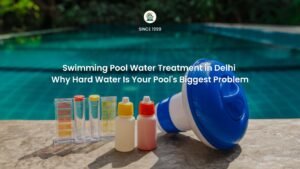
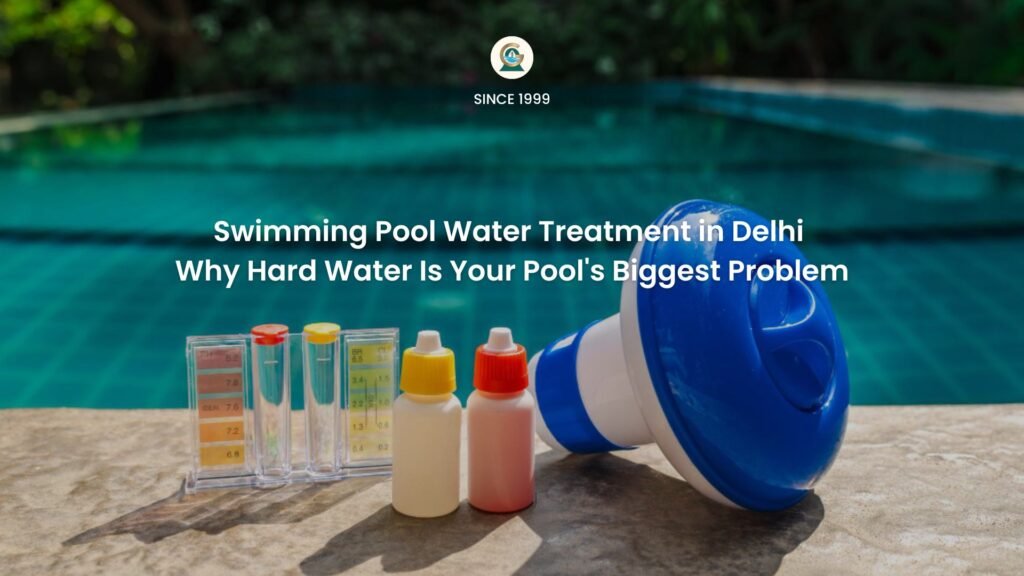
A functional treatment routine for a pool in Delhi NCR tests pH, free chlorine, and total alkalinity at minimum twice a week during the swimming season. It adjusts based on test results rather than fixed dosing schedules. It includes a shock treatment after heavy use, after rain, and at the start of each season. And it includes physical cleaning of filters, skimmer baskets, and pool surfaces frequently enough that organic load stays manageable.
This is not complicated work, but it does require consistency. A pool that is properly treated through March and April will handle the summer significantly better than one that starts behind and tries to catch up in May. The same applies coming out of monsoon season. A pool that is brought back into balance properly in September will stay clean through the winter with minimal intervention.
Where the Maintenance Package Fits In
Our 5-month swimming pool maintenance package for Delhi NCR starts at Rs. 10,000 and covers deep cleaning, chemical cleaning, media change, and the equipment and tools needed for proper ongoing maintenance. It also includes complimentary chlorine, two additional treatment chemicals, and cleaning tools to start. For a hotel, resort, banquet hall, or corporate campus pool, this represents the cost of one problem avoided rather than a recurring expense.
Pool size, site conditions, and the current state of the water and equipment will affect exact scope, which is why a call is the right starting point rather than a fixed quote. You can find the full details on our swimming pool maintenance page, or reach out directly and we will assess what is actually needed for your specific pool.
Questions People Ask About Swimming Pool Water Treatment in Delhi
Q: How often should I test my pool water in Delhi NCR?
A: During the summer months from March through June, test pH and free chlorine at least twice a week. Total alkalinity and calcium hardness should be tested every two weeks. In winter, weekly testing is usually sufficient. Delhi NCR’s hard water and high summer temperatures cause chemistry to shift faster than in more temperate regions, so testing by habit rather than by appearance is important.
Q: Why does my pool water turn green even after adding chlorine?
A: The most common cause in Delhi NCR is pH that has drifted above 7.6, which significantly reduces chlorine’s ability to sanitise. At pH 8.0, chlorine is only about 20% effective. Other causes include UV degradation of unstabilised chlorine, an exhausted filter media that is recirculating fine particles, or an algae strain that has established before chlorine levels were adequate. Test pH before adding more chlorine, and address the underlying cause rather than increasing dosing.
Q: What is media change and how do I know when my pool needs it?
A: Media change refers to replacing the sand or other filtration material inside your pool’s sand filter. Over time, filter media loses its ability to trap fine particles, either through calcification from hard water, channelling from years of backwashing, or simple exhaustion. Signs that media needs changing include pool water that stays slightly hazy despite correct chemistry, filter pressure that runs unusually high or low, and a pool that has not had a media change in more than four years.
Q: Can I manage pool water treatment myself or do I need a professional?
A: Basic testing and chemical dosing can be managed by a trained caretaker with the right test kit and a consistent routine. The gaps that tend to develop with informal management are inconsistent testing intervals, pH being corrected only when the pool looks wrong, and deferred equipment maintenance like media change and filter servicing. A professional maintenance arrangement handles these on a schedule rather than reactively, which makes a measurable difference to water quality over a full season.
If your pool has been struggling with water quality despite regular chemical additions, the issue is almost always in the treatment approach rather than the chemicals themselves. A proper assessment of your water chemistry, filter condition, and dosing routine will usually identify the problem quickly. Visit our swimming pool maintenance page for details on what our Delhi NCR maintenance package covers, or reach out directly for a site assessment.
Disclaimer: Any specific venue, property, or location names mentioned in this article are used for illustrative purposes only. No endorsement or affiliation is implied.