
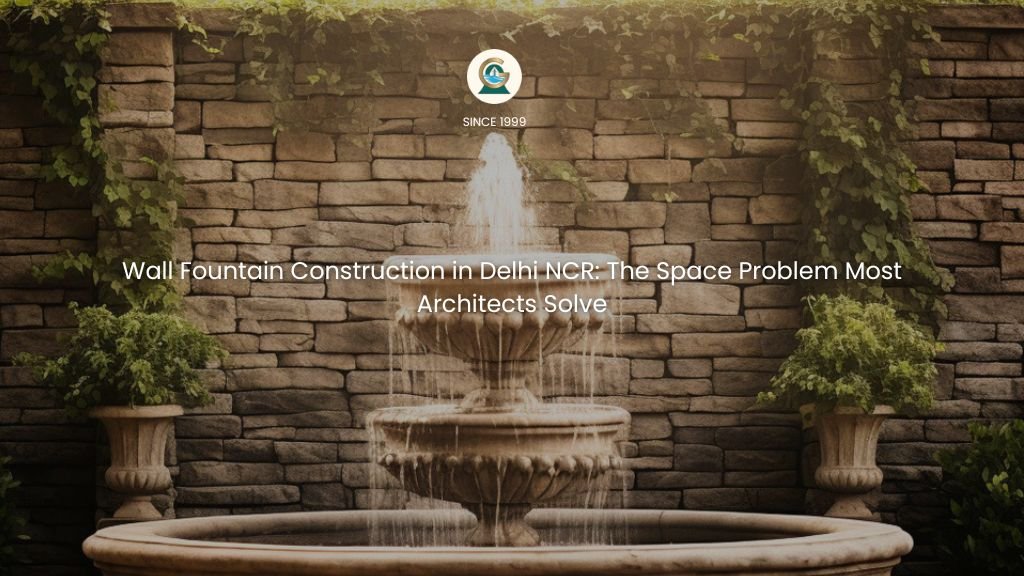
How Wall Fountain Construction in Delhi NCR Solves the Space Problem on Premium Properties
Wall fountain construction in Delhi NCR comes up most often when an architect is working with a premium property that has no room for a traditional fountain footprint. The entrance foyer is generous but not deep enough for a freestanding basin. The hotel corridor needs a focal point but cannot accommodate anything that interrupts foot traffic. The corporate reception has one blank wall that needs to become something. In each of these situations, a wall fountain is not the compromise solution. It is often the better one.
I say that having built water features across Delhi NCR for over 25 years. A well-executed wall fountain on the right surface, in the right location, does more for a space than a mid-sized standalone fountain that was shoehorned in because the client felt they needed water somewhere.
What Wall Fountain Construction in Delhi NCR Actually Requires
A wall fountain moves water down a vertical surface, whether textured stone, a composite panel, a glass sheet, or a structured cascade of materials, and collects it in a basin at the base before recirculating it through a concealed pump system. The effect is a continuous, quiet sheet of moving water that catches light, softens sound, and changes the atmosphere of a space without demanding floor area.
The construction begins with the wall itself. In RCC wall fountain construction, the backing structure, whether an existing load-bearing wall or a purpose-built RCC frame, must be assessed and prepared before any water system is designed against it. Water and structural compromise do not coexist patiently. Moisture ingress behind a wall fountain that was not properly waterproofed at the backing stage will damage the surrounding structure and eventually the interior finishes on the other side of the wall. This is not a risk that can be managed after installation. It has to be eliminated before.
The pump and pipe system for a wall fountain is concealed within the wall cavity, beneath the floor slab, or within a purpose-built service enclosure depending on the site conditions. Every concealed system needs accessible service points. I make this point consistently with every architect we work with on wall fountain briefs because it is the detail most frequently omitted in the initial design and most frequently regretted within two years of installation.
Where Wall Fountain Construction in Delhi NCR Delivers the Most Value
Hotel lobbies and corridors are the most obvious application, and for good reason. A water wall in a hotel lobby in Aerocity or Sector 29 Gurugram performs several functions simultaneously. It creates a visual anchor for the arrival experience. It introduces ambient sound that masks the mechanical noise of a busy lobby: HVAC, foot traffic, conversation. And it establishes an immediate material quality signal to every guest who walks in. Stone or glass moving with water communicates investment and intention in a way that very little else does at that price point.
Corporate office receptions are the second high-value application. Water wall design for corporate spaces in Gurugram’s business districts has become a considered choice among architects who understand that the reception is where clients, recruits, and senior visitors form their first impression of an organisation. A well-built wall fountain in that space is not decoration. It is positioning.
The wall mounted water feature for residential properties is less common but consistently impressive when it is done correctly. An independent home in DLF Phase 5 or a premium apartment in South City with a water wall in the entrance foyer or the main living area carries a quality marker that is immediately apparent to anyone who visits. These projects require more precise calibration of scale. A wall fountain that is too large for a residential interior overwhelms the space rather than enhancing it. When the proportion is right, it is one of the most distinctive residential water features we build.
The Planning Decisions That Determine Whether a Wall Fountain Works
The surface material is the first decision with long-term consequences. Natural stone creates a particular character. The water moves differently across slate than it does across granite, and differently again across a rough-textured composite. Glass panels create a cleaner, more contemporary effect but require more precise flow calibration to prevent sheeting irregularities. The material choice needs to be made in the context of the surrounding interior palette, not in isolation as a standalone aesthetic preference.
Flow rate calibration is more technical than most clients expect. Too little flow and the water clings to the surface inconsistently, creating dry patches and uneven movement. Too much flow and the basin cannot contain the splash, and the sound becomes aggressive rather than ambient. Getting this right requires testing at the site with the actual surface material in place, not calculation alone. We build in a calibration and adjustment phase on every wall fountain project for exactly this reason.
The wall fountain for hotel lobby projects in Delhi NCR has an additional consideration that I raise at every planning meeting: cleaning access. The water surface and the surrounding wall area will accumulate dust and mineral deposits over time. A wall fountain positioned six metres above floor level with no access platform and no cleaning protocol designed in will look neglected within eighteen months regardless of how good the initial installation was. This is a manageable problem when it is thought through at the design stage. It is an expensive problem when it is not.
What Architects Should Confirm Before Specifying a Wall Fountain Contractor in Delhi NCR
An indoor wall fountain contractor in Delhi NCR should be able to discuss waterproofing methodology before they discuss aesthetics. The backing wall preparation, the membrane specification, the junction between the fountain structure and the surrounding floor and ceiling. These are structural conversations, not decorative ones. Any contractor who moves directly to talking about the stone finish without establishing the waterproofing approach first is telling you something important about their priorities.
The electrical specification matters too. Wall fountains with integrated LED lighting, which is most contemporary hospitality and corporate applications, require low-voltage systems properly isolated from the water elements. This is not a complicated specification, but it needs to be explicit in the project documentation before construction begins, not resolved on site by whoever is available that day.
Finally, the pump location needs to be confirmed and agreed before any surrounding construction is finalised. We have been called in to advise on wall fountain projects in Noida and Gurugram where the pump enclosure was inaccessible because the surrounding joinery was installed before the service access was resolved. Fixing that after the fact costs significantly more than resolving it in the design phase, and it is entirely avoidable.
Questions People Ask About Wall Fountain Construction
Q: Can a wall fountain be installed on an existing wall in Delhi NCR?
A: Yes, provided the wall has sufficient structural integrity and the waterproofing can be applied correctly to the backing surface. We assess the existing wall condition during the site visit and advise whether the wall can support the installation as-is or whether additional structural preparation is required. Not every existing wall is suitable, and that assessment needs to happen before a design is proposed.
Q: What maintenance does a wall fountain need in Delhi NCR’s conditions?
A: Regular maintenance covers cleaning the water surface and surrounding stone or glass panel, checking the pump and filtration system, monitoring water chemistry, and inspecting the basin for any early signs of mineral buildup. Delhi NCR’s hard water accelerates scaling on both the fountain surface and the internal pipework. A water treatment system built in from the start reduces the frequency and intensity of maintenance significantly.
Q: How long does wall fountain construction take?
A: A standard wall fountain for a corporate office or hotel lobby typically takes six to ten weeks from site preparation to final commissioning. Projects involving complex surface materials, significant backing wall preparation, or integration with broader interior construction programmes take longer. We discuss realistic timelines at the site visit, not at the quotation stage.
Q: Is a glass water wall or stone water wall better for a hotel lobby in Delhi NCR?
A: Neither is universally better. Each works differently in different contexts. Glass water walls suit contemporary, minimal interiors where the water movement itself is the visual focus. Stone water walls add texture and material warmth that works well in spaces with traditional or layered design languages. The right choice depends on the surrounding palette, the ceiling height, the ambient light conditions, and the effect the architect is trying to achieve. We discuss this in detail at the design consultation before recommending either.
If you are working on a hotel, corporate office, or residential project in Delhi NCR and a wall fountain is part of the brief, the planning conversation is worth having early. The decisions made at the site assessment stage, covering waterproofing approach, surface material, pump location, and maintenance access, determine how well the fountain performs and how much it costs to own over its lifetime. We have been building water features across Delhi NCR since 1999 and we are happy to bring that experience to your project from the beginning. Get in touch when the design process is ready for this conversation.
Disclaimer: Any specific venue, hotel, or property names mentioned in this article are used for illustrative purposes only. No endorsement or affiliation is implied.