
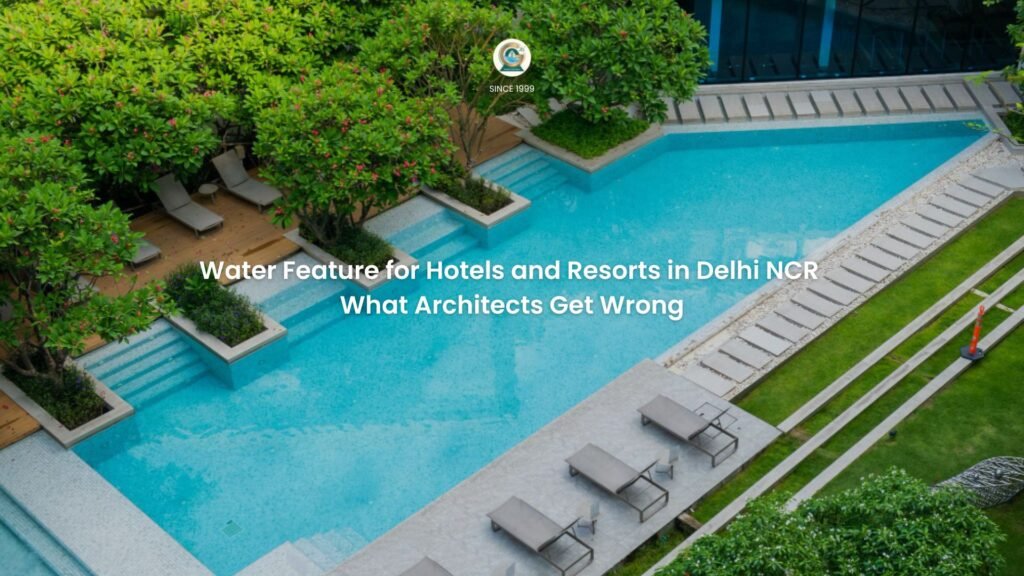
Why the Right Water Feature for Hotels Changes Everything a Guest Feels
A water feature for hotels is not a decoration decision. It is an acoustic decision, a spatial decision, and in many cases the first thing a guest notices before they have even reached the front desk. We have been building these for over 25 years across Delhi NCR, and the difference between a feature that works and one that does not comes down to a handful of choices that most project briefs never mention.
The hotels and resorts we get called to fix are not badly designed properties. They are well-funded projects where someone assumed that a water element would sort itself out in the last phase of construction. It rarely does.
What Most Hotel Briefs Get Wrong About Water Feature Design
The brief usually says something like: fountain in the lobby, or water feature near the pool deck. What it almost never specifies is the acoustic footprint, the viewing distance, the flow rate in relation to ambient noise, or how the feature will read at night versus afternoon.
We spoke with an architect last year who was finishing a resort property near Sohna Road. The developer had allocated space and budget for a lobby water feature. What they had not accounted for was that the lobby ceiling was 24 feet with a marble floor. Every sound in that space amplified. The fountain they originally specified would have sounded like a bathroom tap in a concert hall.
We redesigned the flow configuration during the consultation stage, before a single brick was laid. The difference was not visible on paper. It was entirely felt when you stood in the space.
The 3 Mistakes That Keep Appearing in Hotel Water Feature Projects
1. Treating a Water Feature for Hotels as an Afterthought
Water features are almost always scoped in the final 15% of a hotel construction timeline. By that point, civil work is done, MEP is committed, and the landscape contractor is working around fixed constraints. A water feature built into those constraints will always be a compromise.
The properties that have water elements people actually remember are the ones where the water was part of the structural brief from the start. This matters especially in RCC construction, where the basin, drainage, and structural integration have to be planned before the surrounding area is finished. You cannot pour a concrete water basin as an afterthought into a marble lobby.
2. Specifying by Appearance Rather Than by Engineering
An architect will often bring a reference image: a cascading wall fountain from a hotel in Singapore, or a courtyard pool feature from a resort in Bali. The visual is exactly right. What the image does not show is the pump room, the water treatment system, the recirculation volume, or the noise level at the waterline.
We have seen projects where the fountain looked identical to the reference photograph and was completely wrong for the space. The sound was wrong. The maintenance access was wrong. The water chemistry was unmanaged. A good custom water feature contractor will ask about all of this before they talk about aesthetics.
3. Underestimating the Maintenance Commitment on Hotel Properties
A water feature in a hotel is running every day, in front of guests. The tolerance for a cloudy basin, a pump that makes noise, or algae on the basin walls is zero. A residential pool can miss a week of maintenance. A hotel lobby fountain cannot miss a day.
This is something we address at the design stage, not after handover. The fountain maintenance requirements for a hotel property are different from those of a farmhouse or a banquet hall. Filtration capacity, chemical dosing, and access panels all need to be engineered for daily-use conditions. Retrofitting these is expensive. Including them from the start is not.
What Works Well in Delhi NCR Hotel and Resort Contexts
The properties we have worked on across Delhi NCR have taught us a few things specific to this climate and this audience. A resort near Aravali will have very different considerations from a business hotel in Cyber City or a banquet property off MG Road in Gurugram.
In properties where outdoor areas are the draw, a large recirculating water feature anchors the landscape in a way that planted areas simply cannot. Water reflects light differently at 7pm than at noon. It responds to wind. It creates sound that cuts through the background noise of a crowded terrace without demanding attention.
For indoor lobbies and pre-function spaces, a wall-mounted or channel water feature in RCC keeps the footprint minimal while creating the acoustic softening that high-ceilinged marble spaces desperately need. We have seen this work exceptionally well in banquet halls across South Delhi and Noida. If you are working on a venue brief, our earlier piece on water fountains for shopping malls and large commercial spaces covers the planning framework we use for high-footfall interiors.
What to Discuss With Your Contractor Before the Brief Is Finalised
If you are an architect or a developer briefing a hotel or resort project, these are the questions worth asking before the water feature scope is written:
What is the daily guest exposure to this feature, and what is the acceptable noise level at the nearest seating point? What is the maintenance access situation, and who will be responsible for upkeep after handover? Is the structural slab designed to take the load of a filled RCC basin, or will that need to be resolved? What happens to this feature during the dry season in May and June when evaporation rates in Delhi NCR spike significantly?
None of these questions are difficult. But they are almost never in the original brief, which is why projects that skip them tend to call us three months after opening.
Questions People Ask About Water Features for Hotels and Resorts
Q: What type of water feature works best in a hotel lobby in Delhi NCR?
A: A recirculating RCC wall fountain or channel feature generally works well in enclosed lobbies because it controls the acoustic footprint and does not require the structural depth of a floor basin. The right choice depends on ceiling height, floor material, and the ambient noise level of the space. We assess all three before recommending a configuration.
Q: How long does it take to construct a water feature for a hotel project?
A: RCC water feature construction on a hotel or resort property typically takes four to eight weeks depending on scale, site access, and whether civil integration points are already prepared. Features added after the surrounding construction is complete take longer because coordination with other contractors adds time.
Q: Can a water feature be added to an existing hotel property after construction?
A: Yes, in most cases. The constraints are structural load, drainage access, and power supply for the pump system. We carry out a site assessment before confirming scope. Retrofits are more complex than new-build features, but they are regularly done on operating hotel properties across Delhi NCR.
Q: Who maintains a hotel water feature after construction is complete?
A: Some clients manage it in-house once trained. Others prefer to retain a specialist contractor for ongoing upkeep. We offer swimming pool and fountain maintenance services for Delhi NCR properties and can structure a maintenance arrangement suited to a hotel’s operational schedule.
If you are working on a hotel, resort, or large banquet property in Delhi NCR and the water feature scope is still being defined, that is the right time to have a conversation. We have been doing this since 1999. The earlier we are involved in a project, the more options are available to you. Call us on +91-11-23287653 or reach out through greenevolutions.com.
Disclaimer: Any specific venue, hotel, or property names mentioned in this article are used for illustrative purposes only. No endorsement or affiliation is implied.