
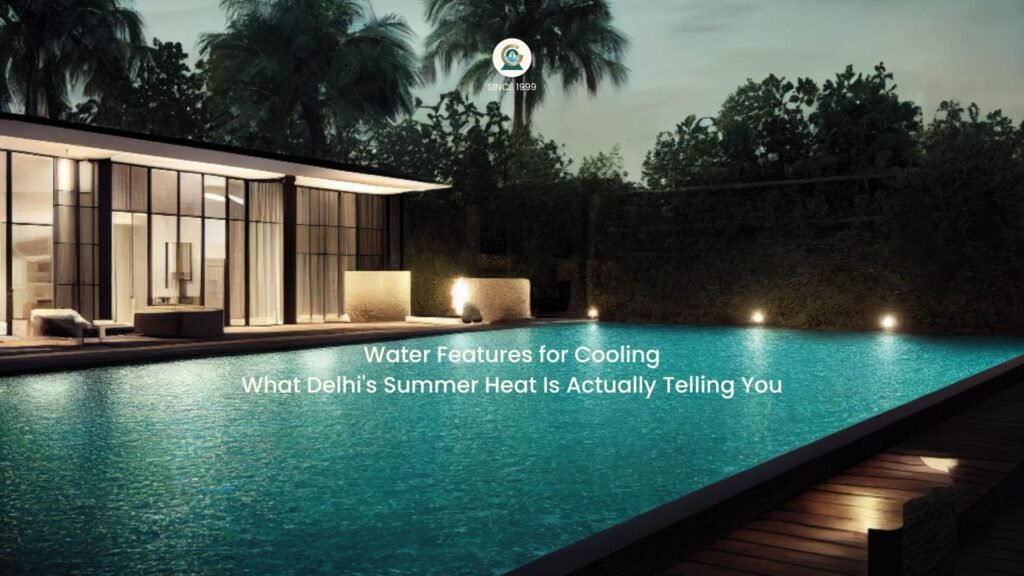
Why Smart Water Features for Cooling Still Get Ignored in Delhi’s Hottest Projects
Water features for cooling are among the most practical decisions you can make for a Delhi NCR property, and yet they keep showing up as afterthoughts on project plans. I was on a site visit in Sector 62 Noida last April, three days before the temperature crossed 44 degrees, and the outdoor terrace of a freshly completed corporate campus had no moving water anywhere. It had stone, it had landscaping, it had expensive outdoor furniture. Just no water.
The landscape architect told me it was a budget cut in the final phase. That answer gets repeated more than it should.
What Water Features for Cooling Actually Do to Ambient Temperature
The science behind this is not complicated. Moving water evaporates continuously. As it evaporates, it draws heat from the surrounding air. A well-placed fountain or water channel in an outdoor space can reduce the perceived temperature by three to six degrees Celsius in the immediate zone around it. In a Delhi summer that sits between 42 and 47 degrees for weeks at a stretch, three degrees matters enormously.
This is not about aesthetics first. At GreenEvolutions, when we plan an outdoor fountain or natural pool for a corporate property or hotel in Delhi NCR, we look at the sun path, prevailing wind direction, and the orientation of seating zones before we talk about form. The function drives everything. The beauty follows.
Why Most Delhi Properties Get This Wrong
Water features for cooling need placement, not just presence
A fountain dropped into a corner of a terrace because that is where the plumber could access a water line is not a cooling feature. It is a decorative object. For moving water to reduce heat meaningfully, it needs to sit upwind of the occupied area, with enough surface exposure to generate consistent evaporation. On a rooftop in Cyber City or an open courtyard in a Golf Course Road property, the placement mathematics are different from a garden in Chattarpur.
We have seen properties in Aerocity and Gurgaon where a water feature exists but is positioned so the wind carries the cooled air away from where people actually sit. The feature looks fine in a brochure photograph. It does nothing useful on a 45-degree afternoon.
RCC construction holds temperature better than lightweight alternatives
The other factor that rarely gets discussed is the material of construction. A reinforced concrete water body, built properly with the right wall thickness and a well-designed recirculation system, maintains a cooler water temperature across the day. It holds thermal mass. When water in a well-built RCC pool or fountain circulates, it is genuinely cooler water meeting genuinely hot air.
Since 1999, every pool and fountain GreenEvolutions constructs uses RCC. Not prefab, not lightweight liner alternatives. The reason is partly durability and partly this exact point: the material itself participates in the thermal performance of the feature.
What Hotels and Corporate Campuses in Delhi NCR Are Actually Asking For
A hotel general manager we spoke with last year, managing a property near Sohna Road, put it this way: guests are deciding whether to sit outdoors based on how the space feels in the first thirty seconds. If it is just hot, they go inside. The outdoor food and beverage revenue disappears. The pool deck stays empty.
The calculation for a luxury hotel or a large corporate campus is direct. Occupied outdoor space generates revenue or reduces attrition. Empty outdoor space is a failed investment. Water, moving water designed for the climate, is what separates the two outcomes.
For architects planning hospitality or corporate projects in Delhi NCR, the water feature conversation should happen at the concept stage, not the landscaping stage. By the time you reach landscaping, the orientation decisions are already locked in.
How Banquet Halls and Farmhouses Are Thinking About This Differently
Banquet properties and farmhouse venues in areas like Chattarpur, Bijwasan, and Kundli have a specific problem. Events happen in the evening, but setup and vendor work happens through the afternoon. A venue with comfortable outdoor temperature management in May and June commands a different conversation with clients than one that is simply a large space.
Several banquet hall owners we have worked with over the years have added custom fountain features not for the wedding photographs, though those help, but because they extended the usable hours of their outdoor spaces. Guests arrive earlier. The pre-dinner gathering actually happens outdoors rather than everyone crowding the air-conditioned lobby.
The investment in a well-placed outdoor water fountain, one that is designed for the wind pattern and sun angle of that specific site, pays back through occupancy and reputation in ways that are genuinely measurable.
Planning a Water Feature Around Delhi’s Summer: What the Design Process Looks Like
Every project we take on starts with a site visit and a conversation, in that order. The site visit tells us what the land is doing, where the shade falls, how the wind moves. The conversation tells us what the client needs the outdoor space to accomplish.
For cooling-focused design, we map the hottest exposure points first. South and west-facing surfaces in Delhi absorb the most heat through the afternoon. A water channel running along a west-facing wall, or a fountain positioned to receive afternoon sun while feeding a sitting area, works with the site physics rather than against them.
The RCC construction process takes this into account from the foundation. The depth of the basin, the recirculation rate, the pipe sizing, all of it is designed for the Delhi climate, not for a generic specification sheet. This is what 25 years of working in this region actually produces: judgment that does not come from a manual.
Questions About Water Features and Cooling in Delhi
Q: Can a water feature actually cool an outdoor space in Delhi’s peak summer?
A: Yes. Moving water evaporates continuously and draws heat from surrounding air. A well-placed outdoor fountain or natural pool can reduce ambient temperature by three to six degrees Celsius in the immediate zone, which makes a meaningful difference in a Delhi summer ranging from 42 to 47 degrees.
Q: What is the best placement for a cooling water feature on a commercial property?
A: The feature should sit upwind of the main occupied area so cooled air moves toward people rather than away from them. On most Delhi NCR properties, this means analysing the prevailing afternoon wind direction before finalising the position. A fountain placed in the wrong location provides visual interest but no thermal benefit.
Q: Does the construction material of a fountain or pool affect how much cooling it provides?
A: It does. RCC construction retains thermal mass, which keeps the water temperature lower across the day. A proper reinforced concrete water body circulates cooler water than a lightweight or thin-wall alternative sitting under direct sun, making the evaporative cooling effect more consistent.
Q: When in the project timeline should we plan for water features?
A: At the concept stage, not the landscaping stage. Once building orientation, terrace levels, and structural elements are fixed, the optimal positions for cooling-focused water features are already constrained. Architects working on hotels, corporate campuses, and large residential projects in Delhi NCR should bring this into the design conversation early.
If you are working on a commercial or hospitality project in Delhi NCR and the outdoor space needs to actually function in summer, not just look good in winter photographs, we are happy to talk through the design options. GreenEvolutions has been doing this since 1999 and we start every conversation by listening. Reach us at +91-11-23287653.
Disclaimer: Any specific venue, hotel, or property types mentioned in this article are used for illustrative purposes only. No endorsement or affiliation is implied.