
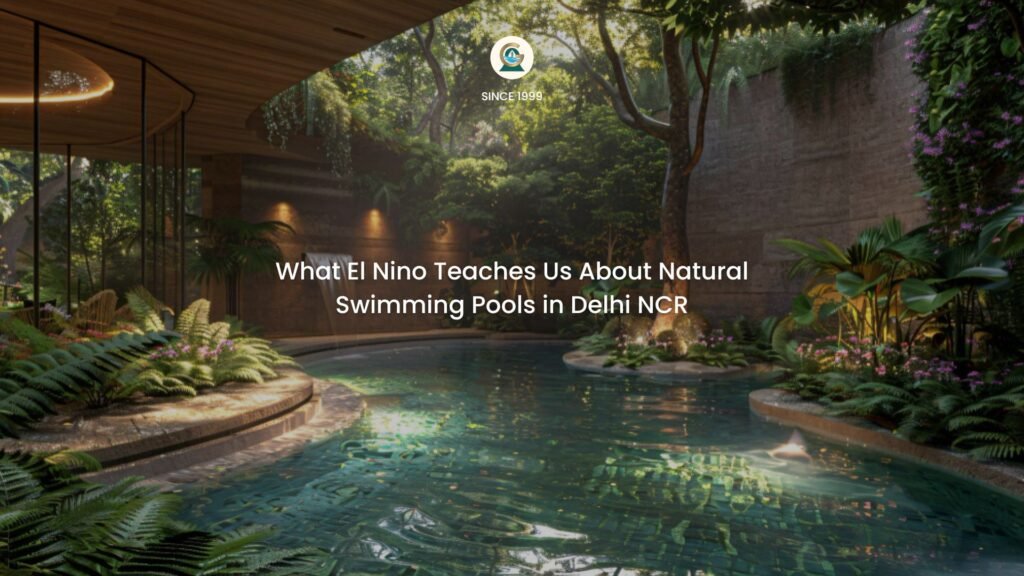
Why the Heat Wave Makes a Natural Swimming Pool in Delhi NCR More Than an Amenity
A natural swimming pool in Delhi NCR this summer is not the same conversation it was even three years ago. El Nino has changed the numbers. June temperatures across Delhi NCR touched 46 degrees this year, and what the forecasts say about the summers ahead is not reassuring. I have been in this work since 1999, building pools and water features in RCC across Northern India, and what I notice now in conversations with architects and property developers is a real shift. They are not asking whether they should add a pool. They are asking something quieter, something more considered about what kind of space they are actually trying to create.
How a Natural Swimming Pool in Delhi NCR Actually Responds to the Heat
There is a physics to this that most people do not consciously think about. Water has what scientists call a high specific heat capacity, meaning it absorbs a significant amount of energy before its temperature rises noticeably. A body of water sitting in a property, especially one designed with natural materials and open to sky, does not just look cool. It draws heat from the surrounding air. The temperature around a well-placed pool or water feature drops measurably. Not enough to fight 46 degrees entirely, but enough to change what it feels like to step outside into a garden or a courtyard.
A natural swimming pool in Delhi NCR built in RCC works with this principle rather than against it. Because the structure is permanent, integrated into the land, and designed with depth and material that holds temperature steadily, it performs differently from a prefab rectangle placed on a terrace. The cooling effect is real and architects we work with raise this in early design conversations. It is not an accidental benefit. It is part of why a water feature belongs in the design from the beginning and not as an afterthought once the building is nearly complete.
What El Nino Is Actually Telling Property Owners and Architects
El Nino is a climate pattern driven by warming of ocean surface temperatures in the central and eastern Pacific. Its effects travel far, disrupting rainfall patterns, delaying monsoons, and intensifying dry heat across large parts of Asia, including Northern India. The 2023 to 2024 El Nino event was among the strongest recorded, and its influence on our summers here in Delhi NCR was visible to anyone who was outside between April and July. Delayed monsoon onset. Record pre-monsoon temperatures. Extended dry spells.
I am not a climate scientist and I will not present myself as one. But 25 years of building across Delhi summers teaches you something the data confirms. The heat is not what it was in 1999. Properties that were designed without considering cooling, shade, or the presence of water feel this acutely now. The architects and developers who work with these sites feel it too. Water is no longer a decorative consideration for a high-end property. It is a functional one.
Why a Natural Swimming Pool in Delhi NCR Is Built Different
The reason we work exclusively in RCC comes down to longevity and structural integrity. Reinforced concrete construction creates something that lasts in Delhi’s conditions. It handles the pressure of temperature extremes, the expansion and contraction between a 46-degree June and a near-freezing January night, in a way other materials reliably do not. A natural swimming pool in Delhi NCR that is built in RCC is not a product installed on a site. It is constructed the way a permanent structure deserves to be.
We have seen what happens when pools are assembled without this discipline. Leaks emerge in the second or third summer. Structures shift under seasonal soil movement. Repair costs end up exceeding what proper construction would have cost from the start. We do not take shortcuts here, partly because it is not who we are, and partly because the summers and soils of Delhi NCR will expose every shortcut that was taken.
Outdoor Fountain Construction and the Urban Heat Question
Outdoor fountain construction in a hotel courtyard, a corporate campus entrance, or a banquet venue garden does something very specific in summer. Moving water creates evaporative cooling. The mist and spray from a well-designed fountain lower the perceived temperature in the immediate area around it. In the dense commercial corridors near Aerocity or in the packed development zones around Cyber City, where every paved surface radiates heat and shade trees are rare, a fountain changes the experience of arriving at a building in a way that is felt before it is understood.
This is why the hospitality sector has become far more serious about custom water features Delhi over the last decade. A luxury resort near Sohna Road or a banquet venue in Chattarpur that has properly designed water in its outdoor spaces is offering guests something that marble floors and expensive lighting cannot. The sound of moving water on a Delhi afternoon in May reaches a person before they have consciously noticed it. That first impression is not accidental when it is designed well.
What This Means for Hotels, Resorts and Banquet Halls in Northern India
A hotel or resort in Northern India competes on experience. The pool, the courtyard fountain, the water element at the entrance, these are not finishing touches. They are part of the reason a guest chooses one property over another, and part of what they remember and describe when they recommend it. We have worked with hospitality and venue developers long enough to know the difference between a property that treats water as central to its design and one that treats it as something added near the end when the budget is already stretched. The difference shows.
For banquet halls and wedding venues in Delhi NCR, summer is a particular pressure point. Guests arriving at an outdoor venue in June need the space to feel hospitable. A fountain courtyard or a water garden integrated into the venue design does not just solve a comfort problem. It creates a visual and sensory identity for the property that photographs well, that guests talk about, and that becomes part of how the venue is described by people who have been there. That combination of function and impression is rare and worth building deliberately.
Working with a swimming pool contractor Northern India who has done this work for 25 years also means navigating the site-specific challenges that come with each property seriously. Water table depth, soil composition, seasonal drainage, equipment specification for outdoor conditions in Northern India winters and summers. These are not generic problems with generic solutions. Each project has its own variables, and getting them wrong is expensive in ways that are not always immediately visible.
Questions People Ask About Natural Pools and Water Features in the Delhi Heat
Q: Does a natural swimming pool in Delhi NCR require more maintenance during summer?
A: Summer does add some maintenance requirements, mainly around water chemistry, algae prevention, and topping up for evaporation loss. A properly built natural swimming pool in Delhi NCR, constructed in RCC with the right filtration and aeration from the beginning, manages this well on a regular maintenance schedule. The key is not cutting corners on the system design at the construction stage, because correcting it afterwards costs significantly more.
Q: Can an outdoor fountain survive the heat and seasonal swings in Delhi NCR?
A: Yes, when it is built correctly in the right materials. RCC structures handle Delhi’s seasonal temperature extremes reliably. The components that need regular attention are the pump, the pipes, and the nozzles, all of which require the right specification for outdoor use in Northern India and a routine inspection schedule before summer and before winter.
Q: Is a natural swimming pool a practical choice for a hotel or resort in Northern India?
A: It is a very practical choice when done with proper construction and design. Natural pools work well in hospitality settings because they bring a calm, organic quality to the outdoor space that a conventional pool cannot replicate. For a resort or hotel in Northern India looking to create a genuinely differentiated experience, RCC pool construction done by an experienced contractor is a long-term investment in guest experience and property value.
Q: How do water features actually help with extreme heat in outdoor spaces across Delhi NCR?
A: Water features and pools create measurable evaporative cooling in the space immediately around them. Moving water, whether from a fountain or a natural pool with proper aeration, lowers the perceived temperature in a courtyard or garden area noticeably during the day. It does not replace shade or mechanical ventilation, but as part of a thoughtfully designed outdoor space in Delhi NCR, water is one of the most effective and pleasant tools available for making a hot afternoon bearable.
We cannot control what El Nino sends. We cannot negotiate with June. What 25 years of building across Delhi NCR and Northern India has shown us is that the properties which invest in water, done properly with the right construction discipline and the right intent, hold something that others simply do not have. If you are designing or developing a property and want an honest conversation about what a natural swimming pool or custom water feature could do for the space, we are here. Reach us at +91-11-23287653 or at greenevolutions.com.